Categories
Book Review Coaching Harvard Business Review Leadership

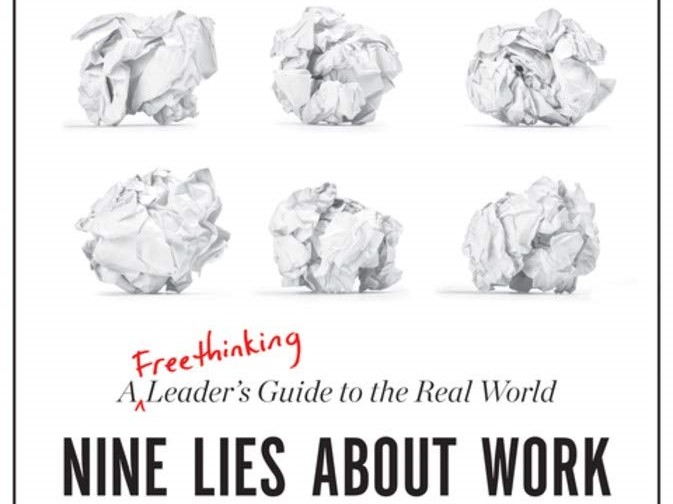
Nine Lies About Work

Nine Lies is a research backed dive into a range of received business knowledge that is less true than it appears on first hearing.

It looks at a range of reasonable sounding statements about organisations and leadership, and strips them back to some real meaning.

The truth is that people find meaning in work through the teams that they work with, more-so than the entire organisation. They understand their own strengths, and are most inspiring when they make use of their strongest ones.

The best companies recognise this. They cascade meaning to the people in their teams rather than enforce obedience. They plan, but only really to gather intelligence about the world. When the world moves on, they throw the plan away, but know where they are going.

The best, most engaged teams are those that trust their leaders, trust each other and know they can do good work every day by bringing their strengths to bear. There’s no simple model, no one-size fits all and no quick measure of what’s good.

Super frustrating for anyone who wants to rely on numbers, models and check-box assessments.

Instead, you need to understand the problem, the context and the people. We all know that you can’t reduce people to numbers, and that some leaders will suit some teams more than others, but in a big org it’s tempting to fall back on the comfort of a spreadsheet or a two-by-two grid.

If you want to build a powerful and engaged org, then the ideas in this book are a great starting point. They’ll guide you on how to understand where you are today, to find the best teams and support them to be even better and to transform every team into one that’s a high performer.

This one’s certainly worth a space on the bookshelf!

Categories
Coaching Leadership

Don’t Assume You’ll Remember It

Another contribution to the power that writing gives you is protection from assuming you’ll remember it.

It’s easy to assume that something that feels important in the moment will be something that you follow up on later. It’s so obvious, so critical and so valuable that you’ll definitely get right on it.

Then the next meeting happens, you get a couple of pings on Slack and you stop for a cup of tea. That vital thing has fallen from top of mind to nowhere, and it doesn’t get done.

Worse than that, you’ve left someone with the impression that it’s going to get done, and whilst you had good intentions, the context switching of daily life has dropped it straight out of your to-do list.

I balance myself against this mistake in a super simple way. I take very brief unstructured notes as I go. If I’ve promised to raise a query to HR, then I’ll drop in a one line comment. If it’s an action to prep some slides for a presentation in a couple of weeks, then it might be a couple of bullet points. A big new strategy might deserve a dozen highlight points that need to be woven into the narrative.

I keep it simple to make sure it gets done, and I clean up when the notes are no longer relevant.

Keeping a doc open all the time to take these reminders down makes them real to me, and the effort it a lot less than trying to keep it all in my head.

You might want to add more structure, preferring a favoured note-taking app or hosted solution. You might keep it lo-fi in a physical notebook. Try different things and find something that you can keep up with. It’s better to be consistent that it is to be perfect.

If elaborate rituals work for you, go for it!

If you think you don’t need to do this, that you remember everything and take every action as agreed, then I’d suggest just trying this for a week or two to see how it goes. You might just find there were things slipping through the net, and even if you don’t, you might enjoy the mental freedom of not having to hold these thoughts in your head.

Writing stuff down isn’t just for shaping the external narrative, it’s a tool to help you be more effective as you counteract the never ending pressure of switching contexts time and time again.

Categories
Coaching Leadership

Know your Audience

Great British Menu is a long running TV cookery programme. Chefs compete to impress a group of judges with dishes that will be served at a banquet hosted at the end of the season.

Each year has a theme (Animation and Illustration in 2023), and the chefs need to connect their dishes to the theme.

The judges are the audience in this experience, and the chefs that perform the best as those that have considered the needs of the audience and adapted to them.

Excellent cookery is a baseline requirement. The banquet element plays a big part, the food should be exciting as well as taste great. The theme is also key. Cook a good dish and link it poorly to the theme, and you won’t be well rewarded.

The long running nature of the programme is also interesting. Certain types of dishes do well, others less so. The main course is the focal point, and shared dishes that are big and impressive often do especially well.

However, dishes that are essentially a ‘picnic’ can fare less well, as they can end up being considered a group of things rather than a coherent whole. There are levels to understanding what the audience wants!

A chef can cook the most technically accomplished dish, and lose out to someone who takes more account of the brief and spends the time to understand what the judges have loved in the past and what they might like in the future.

You can bring this back to your own situation. Think about the audience of your work. What can you find out about them? What do they like? What are they less keen on? What gets a safe 7, vs when might you take a risk to get a 10?

Doing the technically best thing out of context often fails. Don’t make that mistake.

Categories
Coaching Leadership

Hearing Concerns

Not every decision you make will be universally popular. If you aren’t careful then you might focusing on the people who are onboard, it’s often easiest to spend time with those who liked the outcome.

If you fall prey to this temptation, then you’ll miss out on opportunities to make your decisions better in the future, and you’ll also risk only ever hearing the good stuff. Feels good for a while, but bad news tends to get worse if you ignore it.

Hearing concerns is a key technique to balance this risk. You’ve got a decision made, and you spend some time hearing from the people who didn’t feel like they got a good outcome.

Listen to those concerns. Are they merely repeating the expected outcomes? If so, you might push towards “disagree and commit”. It’s usually better to make a good decision and get moving than it is to never make the perfect choice.

You might choose to add something to your decision. Maybe the concern is linked to a secondary metric or an unintended consequence. In this case you can add some extra measurement, or add a review process to ensure the concerning outcomes are well managed.

Rarely, you might choose to change the decision somewhat. Something significant has been raised, a new stakeholder group identified or there’s a wider change in the environment. If you find it’s not rare, then you need to look at how you are gathering information and recommendations to make decisions. Consult with these new stakeholders earlier, or add sources to the input of your decisions.

No matter the choice you make or the outcome off the back of it, by taking the time to hear the concerns of people who are less onboard, you fix some of risks of just pushing on blindly.

We aren’t endlessly opening the door to revisit the decision, so put your efforts on explaining what is going to happen and why that choice has been made. Make sure to reference the concerns that have been raised, so that you can show they’ve been heard, and outline how they are being addressed.

Decisions are worth nothing without implementation, so hearing from those who are holding concerns can help you be more likely to be successful now, and in the future.

Categories
Coaching Leadership

All Good

We use feedback to help us grow, understand what’s going well and think about areas we might be able to improve. Sometimes it feels like we’re only getting positive feedback. We get told we’re doing a great job, but there’s not much actually actionable in the content.

There’s a few different types of “All Good” feedback, and there are couple of different techniques you can use to grab some value from it. So if you feel like you’re just getting positive vibes, but are struggling a bit to progress your goals, dive in and figure out which types of feedback you are working with to let you take it to the next level.

“Good Job”

Super frustrating when you reflect on it. It’s usually an attempt at continuous feedback that doesn’t quite hit the mark. “The presentation was great”, but what about it specifically? What was a real strength, and was there anything that could have been made even stronger.

This type of feedback is real vanity metric stuff. It makes you feel good in the moment, but it doesn’t tell you any specific about what’s really going well. Lean into this opening and ask some valuable coaching questions. “What about it was great?”. “I felt that slide 7 was a bit wordy, what’s your view on that section?”. “How do you feel it landed with the Marketing team?”.

Don’t let these opportunities slip by. Even if the area is a strength you will get better faster with more targeted guidance. Otherwise it’s just like hitting golf balls blindfolded and listening for the applause.

“The quiet parts”

A real problem when you look at feedback coming from more junior people or peers you have to work with often. Even when trust is high, people will still tend to default to positive feedback, rather than leading with areas of opportunity.

If you’ve got three key areas that are important in your role and one is totally missing from your feedback, maybe reflect on why. Imagine you are great at coaching and supporting people but there’s nothing about setting strategy. That quiet part should be a concern, something to follow-up on.

Sometimes you also get some very light criticism flowing through the positive words. If you are reading just the good stuff, this can be easy to miss or gloss over. Instead, try pretending that the softness is a really hard and stark statement. Dial it up to 11 and then figure out if it’s something you want to change or do differently in future. Turn “Makes lots of contributions and suggestions” to “Stifles thoughts of others and takes all the space in the room” and see how that could drive different behaviour.

“Missing people”

A classic end of year performance problem. You’ve only got good feedback because only the people who wanted to share positive stories have decided to.

This can be because you’ve asked a sensible set of people from your stakeholder map, but as it’s easier to share the good stuff, you’ve missed out on all the people who didn’t want to do the work to share growth opportunities.

In which case, try leaning on second order feedback. Ask some trusted colleagues for their thoughts on what the missing people might be saying. Be careful to avoid straying into gossip if you do this, consider starting off by working with your manager (as they are someone who is likely to already be getting some more actionable from these missing voices), and go from there.

Consider as well the benefits of anonymous feedback. Some people will be much more likely to share something useful if it’s not directly attached to their name, especially if mediated through a standard 360 or similar process.

Alternatively, you might have missed some of those less positive stakeholders. Reflect on that map of people who are important to your now and next roles, look at where you’ve not even asked for any thoughts and go and seek them out. Maybe you’ll learn something important through taking the time to extend the reach of your search for feedback.

With any of these approaches you might suddenly get a tranche of new feedback that doesn’t meet your previous expectations. Don’t discount it because it’s different or unexpected, but make sure to take time to reflect on it, seek the useful and good from and use it to learn and grow.

“The Irrelevant”

A sneaky tactic I’ve seen used to deliver “constructive” feedback is to put the positive sounding comments in terms of what you do, but the more difficult sections in terms of what we do or what the organisation does.

If you discard the second part then you are risking doing yourself a massive disservice. “You laid out the options well, but we are not great at making decisions so haven’t moved forwards”. A quick reading is that you did a great job and someone else didn’t.

Try flipping it to “You laid out the options well but it didn’t lead to a decision being made”. How would that make you feel? Does it still feel positive, or does it suggest there’s something to try doing differently in future?

“The Last Job”

Look at the feedback you are getting, and think about the level that it reflects. Is it activities focused towards your next role, or is it all around the expectations of your current job? Even weaker, is it all about your last job?

It’s a painful problem that’s most common amongst people who’ve just been promoted. It’s all too easy to slip back into the comfortable parts of your previous job, and then get positive feedback on doing easy tasks well.

This is the hardest type of positive feedback to fix as it’s not going to get better by seeking out more feedback. Here you need to look at what you are doing, what you should be doing, the gap between the two and how you need to move from one to the other.

Similarly if you want to be promoted, positive feedback on your current role is baseline table stakes, instead work to understand the expectations of the next job, and start doing the work to be in those rooms and get feedback about those activities instead.

If it’s All Good it’s No Good

If all you are getting is positive feedback then it’s going to be really limiting to you in the long term.

Reflect on your situation and the information you’ve gathered and see which of these buckets you fall into. It might be more than one!

Put together an action plan and go out and fix it.

If you aren’t learning you are falling behind, so don’t sit overconfidently on the good stuff. Seek out opportunities as they won’t be handed to you!

Categories
Coaching Leadership

Assuming the Solution

It’s super easy to fall into the assumption trap. You hear about a problem, assume you know what the right solution is and leap to the implementation phase.

It’s especially easy to do this if you’ve got some expertise in the area, or in a space that’s very adjacent. If you’ve got a preferred tool, approach or way of working, then it’s even easier still.

The most difficult times are when your solution is almost certain to work because it’s a big thing. You will fix a specific design issue in a system by tearing it down and starting again. You will fix a leak in a roof by stripping it down and redoing the felt, batons and tiles.

However, you might well cause some new problems. It may cost a lot more than another option you could have pursued. The opportunity cost can’t be ignored, you might have been able to do several things with that effort.

So instead of seeing every problem as a nail and jumping to your trusty hammer, what can you do?

Pull in your coaching mindset and explore a bit. Ask some questions and gather some options. Set your criteria for what success looks like. If you are planning to extend into the loft in a couple of years then the big job might not be necessary and annual maintenance might be more effective.

When people grab quickly at a standard approach or preferred solution then it’s an indication they are not staying curious enough for long enough. Help them lift up the carpet and get a real look at the state of play and open up to other options.

There’s never just one good choice, there’s always trade-offs and there’s certainly more than one way to do it.

Explore, validate and choose, don’t assume!

Categories
Leadership

Tech Debt

Software Engineers talk about Tech Debt all the time, but other than it being a bad thing, they don’t often stop to explain why it’s bad, or why they are going to spend so much time fixing it rather than doing something valuable.

Martin Fowler has some excellent resources that explain this in the words of software systems, choosing to prefer ‘cruft‘ more so than debt. It’s a really strong approach. Debt means different things to different people. In business, debt can be a good thing! It lets you do more now. You claim some of the market, or you grow, and you pay back the debt from excess profits you’ve made. Overall it costs less to take the debt.

Sometimes we squint a bit in software world, take some shortcuts and call it that good kind of debt. Then we take a few more ‘quick wins’, then a few more, until we end up throwing our hands in the air and the Engineers are calling for a re-write.

Instead of that, when we think on ‘cruft’, we can take a more healthy approach. We build the smallest thing we can to service the needs of today. We build it well, and we can change it quickly. Cruft builds up as we learn more, honing what we have to the real needs of the world. Assumptions we made in the past turn out not to be valid, and we need to correct.

By cleaning up as we go we keep on top of things, keep moving fast and keep driving value at pace. If we understand this as cruft not debt, then it’s in the interest of every stakeholder to stay on top of it as we keep going fast by fixing as we go.

Bringing this back to a real world example, I’m busy looking at the windows in my house. Lovely wooden frames, original with real craft put into their creation. However, they’ve not been well maintained. Rather than a quick sand and paint every few years they have been left in the weather for years on end. Patched and painted without repair, then patched on top again.

They look OK from a distance. You could patch and paint again but it’d only cover a couple of years until you need to go again. That’s paying 5x the usual maintenance cost.

You could strip them back fully, repair everything and get into the standard maintenance cycle. That’ll cost most of what a new set will set you back, and they’ll still have some of the neglect baked in.

So you have to take them out, take out some of the supporting sills and lintels that have also been neglected and start again, a big expense but necessary to get a high quality outcome.

Back to software, and you see the same cycle. Build your maintenance in to your plans, fix as you go and don’t let the jobs get away from you. If you have to get something live quickly, then recognise that and double down on improving that area in the near future. Fix a quick fix properly, or it becomes a load bearing layer of your solution.

Don’t accept bad debt and you’ll drive more value faster for longer!

Categories
Coaching Leadership

Getting Better

The trick to getting better at something is to take those small steps forwards. Over time, they can build up to big improvements. It’s a theme that I’ll often return to, as it really is a powerful way to significant progress.

The real trick is getting comfortable with the small steps, and the fact that each one might not feel a lot like progress in isolation. It might even feel like things are getting worse, a super common feeling when you are doing as much DIY as I am at the moment.

So, once you’ve set your big goal, you know the general direction. Then you need to figure out a small step. Think about the time you have, the tools you have, your motivation and current skills. Pull it all together and claim that first step. Visualise what it’ll look like, then do it. Then keep going.

I’ve been repainting the under stairs cupboard, which is something that definitely needed to be broken down into steps, timed around all sorts of commitments, and with a certain amount of skills missing!

Buy the tools, clean up the space. Strip the old paint, and again in the stubborn bits. Clean up again. Final prep and taping round the edges. Actual putting on a coat of paint! Then another. Cleaning up for the final time.

The door still needs to be repaired, but that’s a job for the future.

Each of the steps is approachable, you know what you need to do for each one. Some of them are discovered as you go. They weren’t in an initial ‘plan’, but they we the logical next step from the current position. Some took hours and some a few minutes. There was a stopping point that didn’t involve rehanging a door.

As a big goal it’s a bit overwhelming, it’s not a one day job with all the stages. Each step was much more tractable, it was fitted in when there was time and it was always making progress.

By having regular stopping points I could take satisfaction that each step was progress. Even if some of those early ones didn’t feel like it a the time, I could put them in context of a big goal.

So break down the big goal, pick a small step, do it, stop and reassess, then go again!

Categories
Coaching Leadership

2022 – Top 5

Every year I stop and look back at the Top 5 most popular posts from the year, those that got the most traffic across all sources:

  1. Radical Candor
  2. Coaching Spectrum
  3. Coaching Tools – Scaling
  4. Winning the Performance Review
  5. Coaching Tools – Model T

It’s a familiar list! People love Radical Candor, and are always keen on coaching tools. It’s great to see the Performance Review support making it into the top five for the year, and I’m happy to be sharing it more widely at the most useful time of year to do so.

Here’s a bonus top 3 from my LinkedIn Wednesday Coaching series:

  1. What will make it real?
  2. What don’t you want?
  3. What should they have asked you?

Make sure to join me over there for more of these throughout the year, and why not sit down and answer one of these three questions to get yourself going in 2023.

If you’ve got thoughts for what I could cover over the coming months then I’d love to hear them. More book reviews? Alternative coaching tools? More techniques to show how well you are performing at work and get the recognition you deserve?

Drop me a line at james@jamesosborn.co.uk or connect on LinkedIn, I’d love to hear from you.

Categories
Coaching Leadership

Moving House

I’ve been off schedule because I’ve just moved house, hopefully for the last time in a long time!

It’s really true how much stress this change can bring to you, even though you signed up to it and knew it was going to happen.

So rather than a big long essay about how houses and software are similar (It Depends is not just a software phrase!), I thought I’d give you a chance to reflect a bit on that change, as it’s common to so many of us.

It’s something that’s mostly within our control, where we decide the when, where and how but it’s still really hard work. Whether that’s the size of the change, the new location, the costs or the disruption to daily life, it’s a big impact that can take a lot out of you.

So think about changes where there’s less control to the people undergoing the change. A re-org or change of priorities at work. It’s smaller than uprooting your whole life, but maybe it isn’t to the people it’s impacting in that moment.

Even worse if you live and breathe the change for ages before it happens. You can fall into the trap of thinking it’s smaller than it is.

Go back to moving house, you thought it was easy to cope with, but when you do it, it turns out it wasn’t. Again, you had more control there, the reality didn’t match the story you told.

You need to think about how to communicate changes, think back to these big changes to remind you when things were tough, and build your message with empathy and care.