Categories
Coaching Leadership

Can do anything

When we think about all the various ways we can say yes or no to a request, I sometimes find it helpful to think about it in the following way: We can do anything, but we can’t do everything.

It’s easy to say yes to any request, and end up overwhelmed. It’s equally as easy to say no, due to existing commitments, constraints we feel are currently in play, and other limiting factors.

If we open ourselves to doing anything, but not everything, then we can make sure we’re doing the overall most important thing. It cuts away those constraints of what we’re already doing, and it means that we’re also making sure we’re not just saying yes to dump something else on the pile.

When we’re clear we can’t do everything, we can make sure we’re bringing focus, and setting ourselves up to succeed. It balances the “can you just” type conversation, where we try to add more on to the pile, it protects you from “it should be easy”, and “it’ll be quick as well”. You can talk about the big ambitious highly important thing instead, and then set-out some clear trade-offs and decisions to make.

By being open to doing anything we break out of the limits of today. By being clear we can’t do everything, we give focus to be successful in achieving that big important goal.

Give it a go and see how it feels!

Categories
Coaching Leadership

Go with the Gut

It’s easy to fall into the trap of Analysis Paralysis, endlessly reviewing decisions and never actually doing something.

If you find yourself doing that, then you can break out of the loop by trying to go with your gut.

Don’t spend forever building the decision up, but think about what feels good, and go with that.

It’s best to use this approach for smaller decisions, especially in areas that you are familiar with or that give you an option to undo if really necessary. It’s a topic I’ve written about before, but it’s really useful to remember that there are very few decisions that are truly irreversible.

If it feels a bit overwhelming, break up choices into smaller decisions. One thing that often drives the paralysis is the scope or the implication that you feel of the decision. Don’t get hung up on the colour scheme of your entire house, just paint a room in a colour you like the feeling of. If it looks good, great! If not, it’s a smaller investment to correct than having done the whole building.

When we look to our gut, it’s good to run a few checks before really trusting it. Is this an area that you are confident in? Is it really a familiar space for you to make a decision? Is there a way to make it smaller or easier?

Finally, check your bias. Especially in cases where it’s a decision related to people not things. If you like a particular way of doing things, or are comfortable with an approach, make sure you aren’t layering that bias onto the decision. Challenge this with a quick checklist or a way to score performance. Sometimes you break the paralysis by having the tools in hand to make the decision before you are called to think about it.

So, if you find yourself getting stuck, find some opportunities to make quick decisions and measure the outcome, and use this to hone your approach to make a choice faster.

No decision is still a decision, and don’t let Analysis Paralysis force the non-choice upon you by default!

Categories
Coaching Leadership

Don’t force the Process

Requiring a uniformity of process caps the highest potential of your teams.

Process protects us from making mistakes, and can lift every team to a good level. Forcing this is what stops us finding the truly great performances.

We sometime fall to uniformity when we find it hard to measure the outcomes that teams are driving. Measuring adherence to a process is often easy. It’s easy to count the number of widgets that are being created, and it’s easy to see if we’re all doing it in the right way. It’s not always easy to determine if we’re doing the smart things that actually achieve the outsize results.

A classic example of a mistake is to enforce Scrum, or any other particular flavour of agile. The more tightly it’s enforced, the less likely you’ll get a 10/10 team performance.

Instead, go back to the Agile Principles. The best architectures, requirements and designs emerge from self-organising teams. At regular intervals, the team reflects on how to become more effective, then tunes and adjusts its behaviour accordingly.

An overly rigid process hinders this adjustment. It doesn’t recognise the unique context of the team, and that’s where the potential is capped.

By all means, if your org needs certain things reported, or activities that must be done for legal reasons then you can require that of the teams. Beyond those must do things, you should instead encourage your teams to experiment and find out what works best for them.

The goals of leadership in this model is to share the things that are working, and also the things that aren’t. Giving access to the tools that can support, and taking away the noise that breaks focus.

It’s imperative that you don’t just allow each team to meander through the path to excellence!

So forcing a process can take you up to good, coaching teams and sharing the best outcomes widely will help you achieve greatness.

Categories
Coaching Leadership

Smaller Risks Less Allowed?

There’s a common pattern as anything moves through a maturity curve of people being less open to risk.

Wen something is new and exciting, we can do lots of new and exciting things. When organisations are small, it’s easy to make a change, and one reason is we’re still open to the risk of it not working out.

As things mature, people get more used to ‘how they are’. Big orgs become more focused on maintaining what’s working, and that means taking fewer risks.

It’s harder to drive change, and in an ever faster moving world, that lack of flexibility soon becomes a major risk itself.

It’s important to identify these situations, and then look for ways to counteract the change. We don’t invite anarchy into a large organisation, but we must stay open to the desire to change.

To help frame these thoughts, imagine some of the inventions of the last couple of centuries. If cars were invented today then they wouldn’t be allowed out on the road. The risks we accepted then were far different to those we accept today. Similarly, improvements to cars are always having a higher bar to entry, we’re less willing to tolerate smaller risks, but things we have accepted for a while carry on being thought of as ‘fine’ to the general populace.

In a growing organisation, the same thing happens. Existing policies and practices are accepted, but changes get harder to make. We put people in place who are rewarded on the basis of successfully operating these processes, and often incentivise risk reduction rather than value capture.

Some of this behaviour is vital! The larger the org the higher the chance of an internal bad actor. We need to protect against this. We have changing legal responsibilities that we must meet. We have grown due to being successful, and it makes sense to protect that success.

Too much however, is dangerous. We have to be able to adapt when circumstances change. We need to be confident in taking some risks when the situation is ambiguous or opportunity is at hand.

So what can we do?

Beg forgiveness – A strategy that’s high risk in and of itself. If you are right it’s all likely to be good, but be ready to accept some consequences, especially if you realise some of those risks!

Seek support – Find someone more senior who agrees with your approach, and get them to sign off on it. Processes often exist to make decisions without needing to involve an important person. Get that backing to step around the process and get moving. Build trust with smaller things, and this approach will even work for some significant changes.

Change the system – Hardest option, but biggest long term payoff. It’s easy to put something in place to prevent a risk occurring, it’s harder to remove or streamline it. So, taking on that task might not be easy, but getting rid of an outdated practice will let everyone move faster.

As organisations grow, they can be less receptive to change. Smaller risks become less allowed.

If you see this happening, use some of these techniques to free up the capacity to change. The world moves on, you need to move with it!

Categories
Coaching Leadership

Practice

Practicing helps you to be prepared for what’s coming up. Doing it by yourself is certainly effective, but it’s even better if you enlist some support.

Practicing in the open, with some trusted support, can really help you get on top of the extra value you could provide. It’s all about how what you are doing will land with others, which is super important in a business context.

Getting support in this way is where you take the practice to the next level.

Imagine you are giving a 10 minute presentation. Create your outline, put some slides around it and get your script in place. Work out the big blocks, and then you are good to get some support.

Book an hour to practice in person. Go for a first run through. Ask your supporter “What did you take from the presentation?”. If they hit your key message, then that’s great, jump to refinements. If not, shift up the approach to try and land that core message.

If you are refining, then ask about what felt weak, and what felt strong. Squash the weak parts, edit out the waffle, reframe so the punchy statements hit first.

Make sure that the strong parts come together nicely, that you have a good pace and the story flows.

Then go again, start by giving the slides that you’ve changed the most. Are they landing well with the audience? If not, go again.

Run this loop for the middle 30 minutes of your session.

In the last 15, give the presentation again, and take a fresh round of feedback. It should be loads better. Stronger message, better put together and lands well with your audience.

Preparation is key, practicing in the open takes it up to the next level.

Categories
Coaching Leadership

Trust

Trust is a brilliant thing. Trust people to perform and they are much more likely to knock it out of the park. When you are trusted you see a lot fewer of the bad behaviours that can make your working life tougher than it needs to be.

So building up trust is a super power, and accelerating that build-up really compounds the benefits.

It’s simple, but not always easy, to build up trust when you have the power. When you are the boss, you can just ask people to do something and tell them you trust them to achieve it. The bit that comes next, which can be hard, is that you need to let them go away and do the thing. No backseat driving or looming over the shoulder. Instead, figure out a plan to check in at the start, and stick with it.

Then just keep doing that!

On the flip side, where you don’t have the power, it’s about this fundamental statement. “Do what you said you’d do, when you said you’d do it”.

Both parts are key, one without the other is useless for building trust. Doing less or being late will both erode trust, and can do so quickly. It’s harder to build up trust than it is to lose it.

Again, this is simple to say, but might not be easy to do. You both need to have a strong understanding of the “what” and the “when”, and clear agreement on what these look like.

You need to keep doing it. Start with small things, do what you said you’d do, when you said you’d do it. Do it again. And again.

Consistency is key, a bedrock to the formation of trust.

With trust you’ll do more, you will be happier, your org will be happier and you’ll achieve more!

Categories
Book Review Coaching Leadership

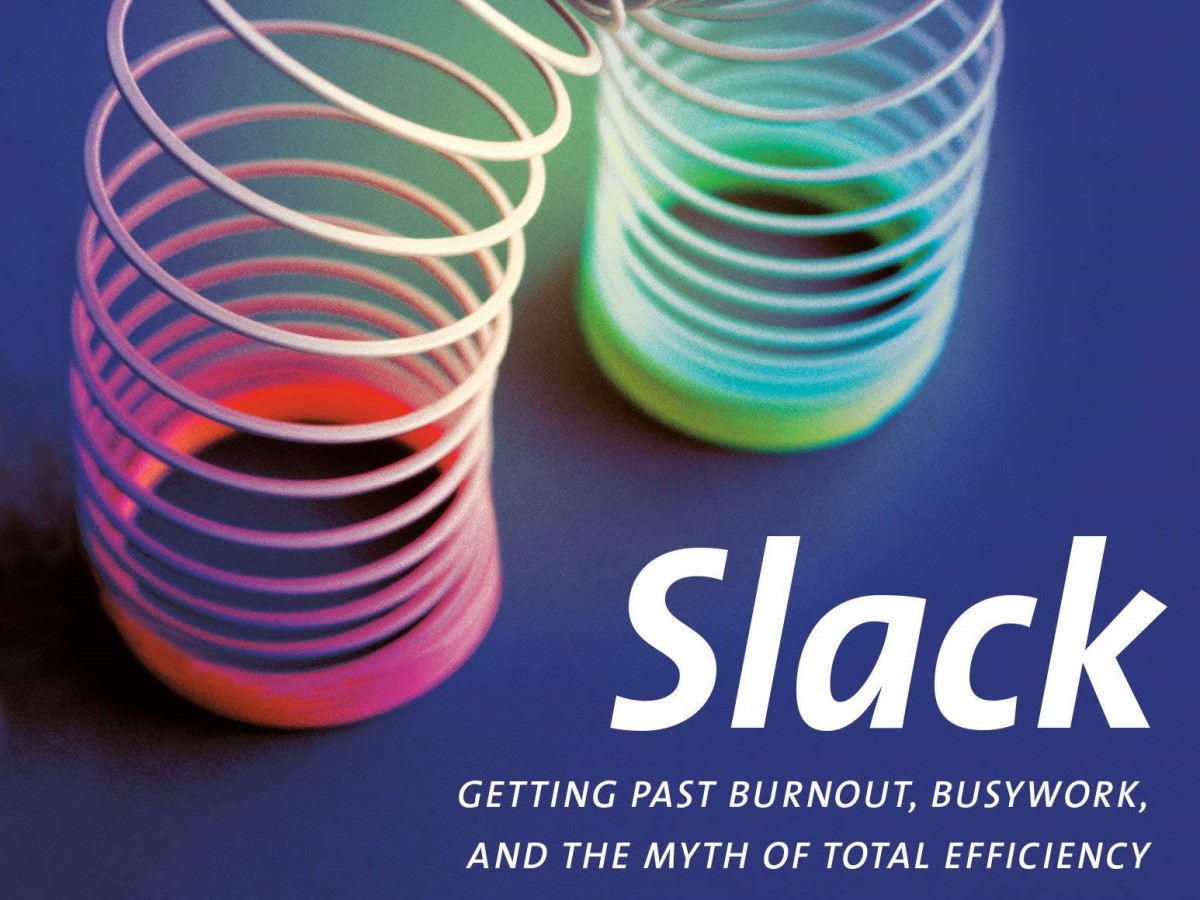
Slack

Tom de Marco’s Slack is a great example of why we should go back to the classics, rather than chase the hotness of the thousand new business books released every month.

It’s short and powerful, and hits you with the core message early and often. Efficient organisations are brittle. They cannot react to changing conditions, and things often take longer to achieve end-to-end.

Instead, we should strive to be effective by ensuring there is Slack in the system.

We recognise that people are not fungible units of resource. It takes time to change contexts, to build expertise and to get good at a job. Splitting someone’s focus to two tasks comes with an effectiveness cost. Splitting them to several means they may as well not be there. The orchestration costs more than the benefit they bring.

Sometime you need people to not be 100% busy, so they can do the important thing when it turns up. The value is in being able to absorb the change, and to be effective you need to accept the ‘cost’ of them not ‘producing’ all the time.

More pressure slows people down, knowledge work requires space to think, experiment and think again. You don’t get better long term outcomes by forcing more onto people, you get better outcomes by them having space to breathe.

Tom takes us through thoughts on how to scale this thinking to the organisation, on the right time to drive change (before things go bad), and why the connecting layer of leadership is key to giving you this successful org.

Watch out for the push to efficiency if you want to be effective!

Categories
Coaching Leadership

An Embarrassment of Riches

Warning everyone, some sports metaphors ahead. Bear with me if that’s not your thing, as it’s highlighting an important topic!

Smart people know that it’s teams that get things done, not individuals. That’s true no matter how excellent the individual people may be that form the team.

Superstars are often only superstars because of the context they play in, in a different team or setup they can suddenly look very average indeed. Even where someone might seem to transcend a bad fit, there’s almost certainly a better setup where they could excel even more.

It happens all the time when a club player steps up to the national team. Marcus Smith is a standout rugby player when he’s with Harlequins, but lining him up with Owen Farrell in the England setup didn’t work, because the asks, expectations and context are different. Setup the England team using the Harlequin approach with international talent, and you’d get a turbo charged Smith.

Forcing people into the setup doesn’t work. It’s a classic mistake of a coach, and it’s a common mistake of managers too.

Think about your team, what skills do they need, how do they work together. What’s hard, what’s easy.

Look at the options you have available. What are these people’s skills? What will they bring extra or new? How will their strengths compliment the needs of the team?

Then ask yourself how much you are willing to change to get the very best from the person you are bringing in? How long can you give the team to adapt, and how will you support them?

If the answers don’t line up, then no matter how good the person is, they might not be the right choice to make now.

The best teams are not the best set of individuals if those individuals can’t gel together.

Don’t build a team of superstars, build a super-star team.

Categories
Coaching Leadership

Small Wins

I’m big on building momentum to drive positive change, and I’ll probably keep writing about how small steps get you there forever.

A big part of this is taking time to celebrate the small wins. They really have an outsize impact as you work to make big changes.

As you know if you’ve been around here for a while, I’ve been doing some work on my house, and so I’ve been getting to celebrate a lot of small wins. One of the less exciting jobs is to clean the radiators (seriously, go and have a look down them if you haven’t done this before!).

I didn’t want to pour water down them, so it’s time for dusters and a vacuum cleaner and what felt like was going to be a bit of a slog. Before going too deep I had a good look at the radiators and found that they had a cover that looked like it might come off. With a couple of quick YouTube searches, I found the matching type and had the knack of taking the cover off.

It was immediately massively better than trying to clean them with the cover on. By taking a few minutes out to make things better I both managed to do a far better job, and do it in less time overall.

It’s just a small job, but by not rushing and doing the prep right, it left me feeling a lot happier.

So where can you find your small win for a better overall outcome?

Categories
Book Review Coaching Harvard Business Review Leadership

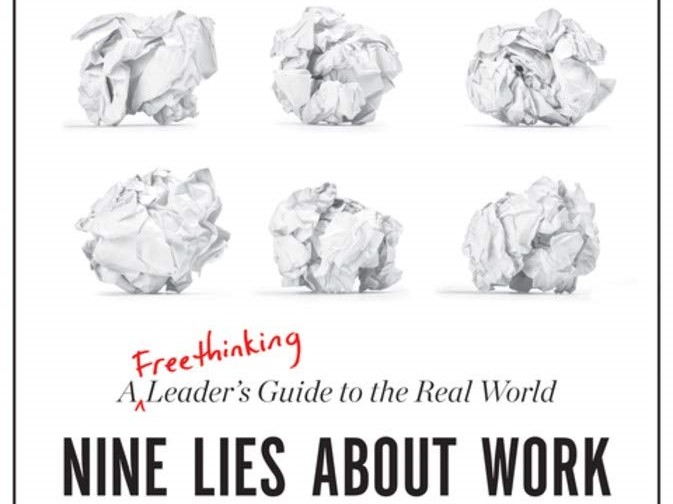
Nine Lies About Work

Nine Lies is a research backed dive into a range of received business knowledge that is less true than it appears on first hearing.

It looks at a range of reasonable sounding statements about organisations and leadership, and strips them back to some real meaning.

The truth is that people find meaning in work through the teams that they work with, more-so than the entire organisation. They understand their own strengths, and are most inspiring when they make use of their strongest ones.

The best companies recognise this. They cascade meaning to the people in their teams rather than enforce obedience. They plan, but only really to gather intelligence about the world. When the world moves on, they throw the plan away, but know where they are going.

The best, most engaged teams are those that trust their leaders, trust each other and know they can do good work every day by bringing their strengths to bear. There’s no simple model, no one-size fits all and no quick measure of what’s good.

Super frustrating for anyone who wants to rely on numbers, models and check-box assessments.

Instead, you need to understand the problem, the context and the people. We all know that you can’t reduce people to numbers, and that some leaders will suit some teams more than others, but in a big org it’s tempting to fall back on the comfort of a spreadsheet or a two-by-two grid.

If you want to build a powerful and engaged org, then the ideas in this book are a great starting point. They’ll guide you on how to understand where you are today, to find the best teams and support them to be even better and to transform every team into one that’s a high performer.

This one’s certainly worth a space on the bookshelf!