Categories
Book Review Coaching Harvard Business Review Leadership

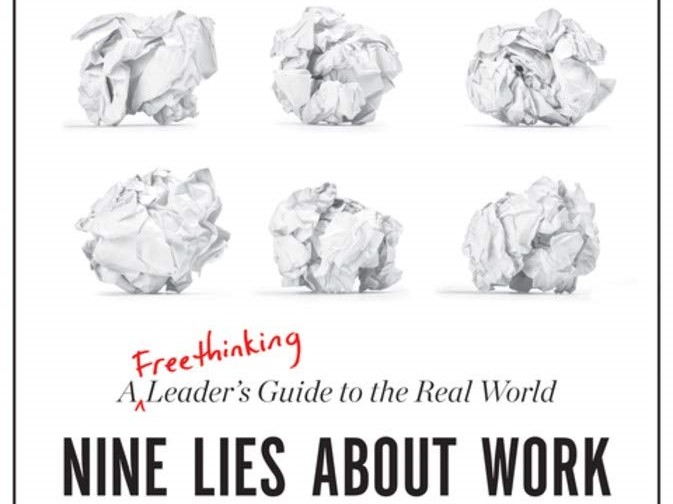
Nine Lies About Work

Nine Lies is a research backed dive into a range of received business knowledge that is less true than it appears on first hearing.

It looks at a range of reasonable sounding statements about organisations and leadership, and strips them back to some real meaning.

The truth is that people find meaning in work through the teams that they work with, more-so than the entire organisation. They understand their own strengths, and are most inspiring when they make use of their strongest ones.

The best companies recognise this. They cascade meaning to the people in their teams rather than enforce obedience. They plan, but only really to gather intelligence about the world. When the world moves on, they throw the plan away, but know where they are going.

The best, most engaged teams are those that trust their leaders, trust each other and know they can do good work every day by bringing their strengths to bear. There’s no simple model, no one-size fits all and no quick measure of what’s good.

Super frustrating for anyone who wants to rely on numbers, models and check-box assessments.

Instead, you need to understand the problem, the context and the people. We all know that you can’t reduce people to numbers, and that some leaders will suit some teams more than others, but in a big org it’s tempting to fall back on the comfort of a spreadsheet or a two-by-two grid.

If you want to build a powerful and engaged org, then the ideas in this book are a great starting point. They’ll guide you on how to understand where you are today, to find the best teams and support them to be even better and to transform every team into one that’s a high performer.

This one’s certainly worth a space on the bookshelf!

Categories
Coaching Leadership

Don’t Assume You’ll Remember It

Another contribution to the power that writing gives you is protection from assuming you’ll remember it.

It’s easy to assume that something that feels important in the moment will be something that you follow up on later. It’s so obvious, so critical and so valuable that you’ll definitely get right on it.

Then the next meeting happens, you get a couple of pings on Slack and you stop for a cup of tea. That vital thing has fallen from top of mind to nowhere, and it doesn’t get done.

Worse than that, you’ve left someone with the impression that it’s going to get done, and whilst you had good intentions, the context switching of daily life has dropped it straight out of your to-do list.

I balance myself against this mistake in a super simple way. I take very brief unstructured notes as I go. If I’ve promised to raise a query to HR, then I’ll drop in a one line comment. If it’s an action to prep some slides for a presentation in a couple of weeks, then it might be a couple of bullet points. A big new strategy might deserve a dozen highlight points that need to be woven into the narrative.

I keep it simple to make sure it gets done, and I clean up when the notes are no longer relevant.

Keeping a doc open all the time to take these reminders down makes them real to me, and the effort it a lot less than trying to keep it all in my head.

You might want to add more structure, preferring a favoured note-taking app or hosted solution. You might keep it lo-fi in a physical notebook. Try different things and find something that you can keep up with. It’s better to be consistent that it is to be perfect.

If elaborate rituals work for you, go for it!

If you think you don’t need to do this, that you remember everything and take every action as agreed, then I’d suggest just trying this for a week or two to see how it goes. You might just find there were things slipping through the net, and even if you don’t, you might enjoy the mental freedom of not having to hold these thoughts in your head.

Writing stuff down isn’t just for shaping the external narrative, it’s a tool to help you be more effective as you counteract the never ending pressure of switching contexts time and time again.