Categories
Book Review Coaching Leadership

Team Topologies

Team Topologies is a great book by Matthew Skelton and Manuel Pais. It gives you methods to organise your technology teams for fast flow, and a simple way to categorise those teams.

It’s a short and punchy book broken into three key sections. We start with Org Charts, Conway’s Law and teams as the unit of development. The second section takes you into the meat of the book, covering team anti-patterns, the four fundamental topologies and how you might choose sensible boundaries. The last section is focused on interactions between the teams, and methods of iterating towards the structure.

The big ideas are really around long lived teams as the unit of software delivery, that there are only really a few types of team, and that we can choose to target high flow and iterate towards it over time.

Flow doesn’t mean efficiency, so a lot of the identified anti-patterns are where an organisation has attempted to be efficient (handing over work, creating queues and specialist groups), targeting least overall effort, rather than soonest delivery of value.

The book highlights a number of times that you must have good engineering practices as a pre-requisite. If you are not able to release software easily and with confidence, or to do so in an automated manner, then you will need to fix that before gaining value from this structure.

It’s also clear through the book that attempting to suddenly move all teams into the model on day 1 is unlikely to work, that iterative and adaptive approach is most likely to be successful, especially via the analysis of cognitive load on teams, and splitting responsibilities where they are overloaded.

I think it’s easy to get excited by the simplicity provided in the book, with four team types and three interaction modes, there’s a lovely easy classification system, and engineers love to put things into buckets or give them a label.

In a mature existing org it’s unlikely that you’ll get a perfect one to one mapping ever, but the taxonomy does give you a chance to start using the same language when describing teams, and an ideal to aim towards.

The case studies and tips scattered through the book bring this to life. Iterations on orgs take years not days, as they need to bed in and become part of the culture. The first thing you try is going to be wrong, so the examples where people have iterated over time are particularly enlightening.

I think that a lot of the core ideas will be familiar to org minded thinkers, but they are pulled together in a compelling way. There’s a lot of value in the approaches outlined, but they require discipline to understand fully, to recognise the foundations that must be in place to be successful and the willingness to iterate as the org continually moves forwards.

Simplicity is hard, don’t fall into the trap of thinking it’ll all be easy once your leadership team has read the book and you’ve rebadged all your teams in team topologies terms.

Be willing to put in the work, and you’ll be rewarded with a shared set of terminology, and a repeatable process for building out teams that deliver the maximum possible value in the shortest time.

Categories
Coaching Leadership

An Embarrassment of Riches

Warning everyone, some sports metaphors ahead. Bear with me if that’s not your thing, as it’s highlighting an important topic!

Smart people know that it’s teams that get things done, not individuals. That’s true no matter how excellent the individual people may be that form the team.

Superstars are often only superstars because of the context they play in, in a different team or setup they can suddenly look very average indeed. Even where someone might seem to transcend a bad fit, there’s almost certainly a better setup where they could excel even more.

It happens all the time when a club player steps up to the national team. Marcus Smith is a standout rugby player when he’s with Harlequins, but lining him up with Owen Farrell in the England setup didn’t work, because the asks, expectations and context are different. Setup the England team using the Harlequin approach with international talent, and you’d get a turbo charged Smith.

Forcing people into the setup doesn’t work. It’s a classic mistake of a coach, and it’s a common mistake of managers too.

Think about your team, what skills do they need, how do they work together. What’s hard, what’s easy.

Look at the options you have available. What are these people’s skills? What will they bring extra or new? How will their strengths compliment the needs of the team?

Then ask yourself how much you are willing to change to get the very best from the person you are bringing in? How long can you give the team to adapt, and how will you support them?

If the answers don’t line up, then no matter how good the person is, they might not be the right choice to make now.

The best teams are not the best set of individuals if those individuals can’t gel together.

Don’t build a team of superstars, build a super-star team.

Categories
Book Review Coaching Harvard Business Review Leadership

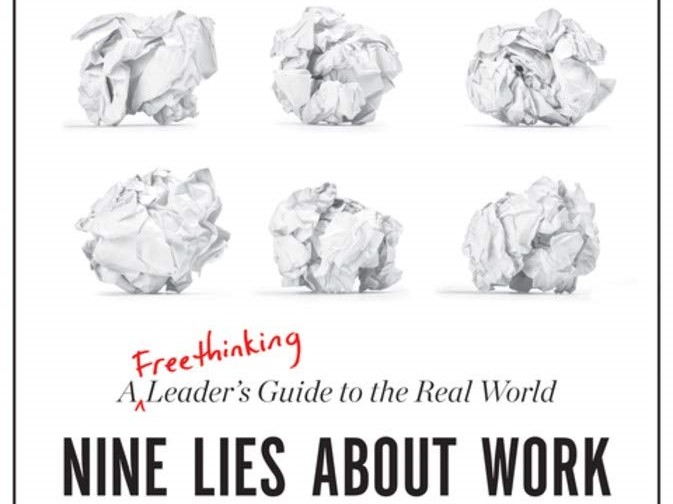
Nine Lies About Work

Nine Lies is a research backed dive into a range of received business knowledge that is less true than it appears on first hearing.

It looks at a range of reasonable sounding statements about organisations and leadership, and strips them back to some real meaning.

The truth is that people find meaning in work through the teams that they work with, more-so than the entire organisation. They understand their own strengths, and are most inspiring when they make use of their strongest ones.

The best companies recognise this. They cascade meaning to the people in their teams rather than enforce obedience. They plan, but only really to gather intelligence about the world. When the world moves on, they throw the plan away, but know where they are going.

The best, most engaged teams are those that trust their leaders, trust each other and know they can do good work every day by bringing their strengths to bear. There’s no simple model, no one-size fits all and no quick measure of what’s good.

Super frustrating for anyone who wants to rely on numbers, models and check-box assessments.

Instead, you need to understand the problem, the context and the people. We all know that you can’t reduce people to numbers, and that some leaders will suit some teams more than others, but in a big org it’s tempting to fall back on the comfort of a spreadsheet or a two-by-two grid.

If you want to build a powerful and engaged org, then the ideas in this book are a great starting point. They’ll guide you on how to understand where you are today, to find the best teams and support them to be even better and to transform every team into one that’s a high performer.

This one’s certainly worth a space on the bookshelf!